Guides

The Everyday Money Reset

Four complete, free, plain-English guides to help you take a practical next step in debt organization, realistic budgeting, credit understanding, and starting an emergency cushion.

Note: Credit systems and consumer protections vary by location.

Choose where to begin

A quick comparison of the four guides

Pick the topic that feels most useful right now. Each guide is written in plain English and designed for practical first steps.

  • Organizing debts

    Useful when you want one clear view of what is owed, what is due first, and how to track payments without guesswork.

    Jump to this guide
  • Budgeting for changing expenses

    Useful when your monthly costs shift and you need a simple plan that can flex without starting over every month.

    Jump to this guide
  • Understanding credit reports and scores

    Useful when you want to read your report with more confidence and understand how scoring works, noting systems vary by location.

    Jump to this guide
  • Planning a first emergency cushion

    Useful when you want to start a small reserve for unexpected costs and decide on a realistic first target you can build gradually.

    Jump to this guide

Guide 1 · Everyday Money Reset

A clear way to organize your debts.

This guide is about organizing information and choices, not judging your situation. Whether you have one balance or several, a clear list can reduce guesswork and help you choose your next step with more confidence.
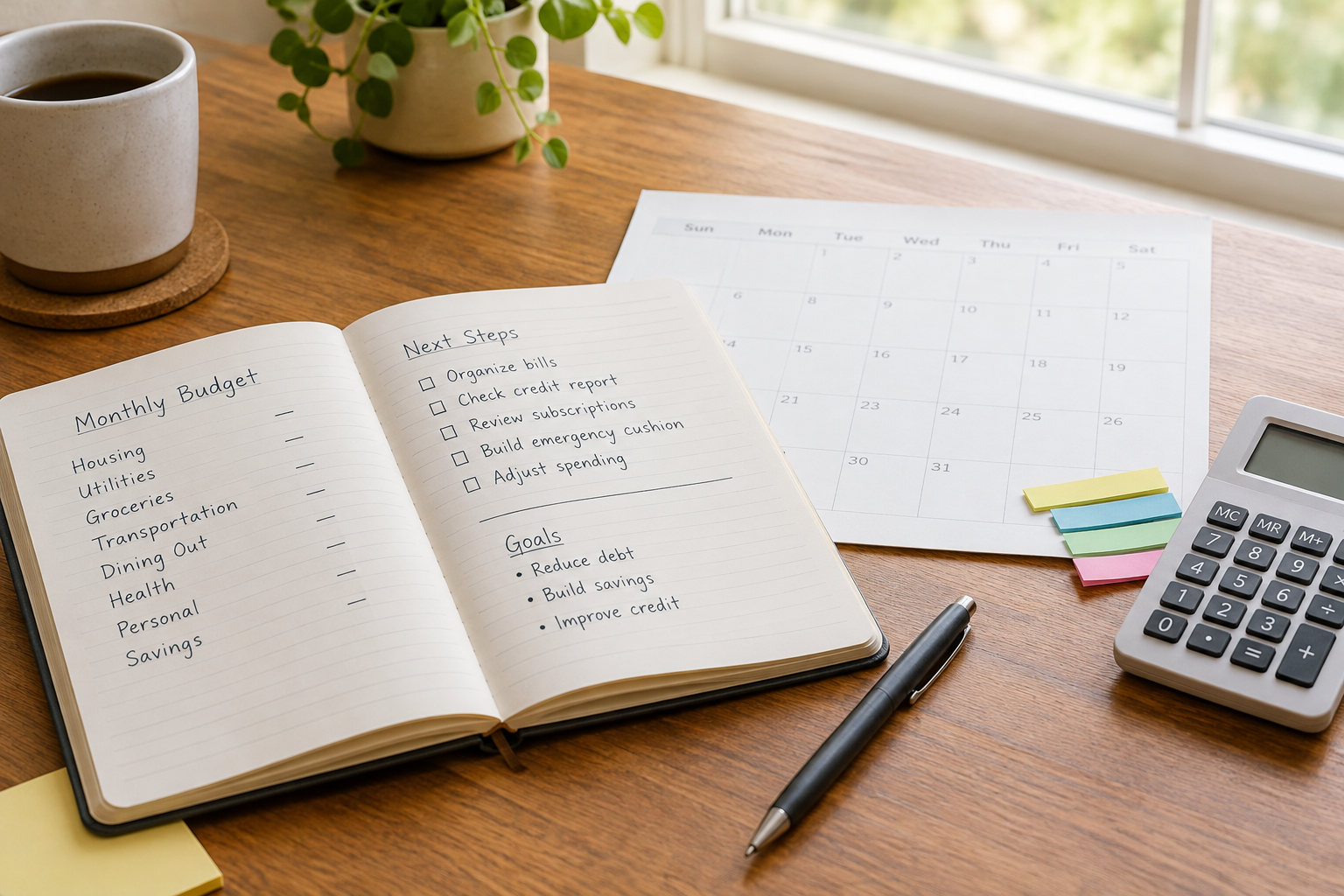
Open notebook with handwritten budgeting notes, monthly calendar, sticky tabs, and a calculator on a wooden table in natural window light
A simple paper list can be enough to start.

Step 1: Gather each account in one place

Start with statements, app screenshots, or letters. Put every account on one page so you can see the full picture at once. If details are missing, leave a blank and fill it later.

Step 2: Capture the core facts

For each account, record only the details you need to make decisions:

  • Current balance
  • Due date
  • Minimum amount due
  • Interest rate or fee notes, if known
  • Any urgent notes (for example: already late, fees increasing, contact requested)

Step 3: Mark priorities before choosing a plan

Not every person uses the same priority order. Some focus on urgency first, others on total cost, and others on simplicity to build momentum. The best starting point is the one you can follow consistently.

How to think about tradeoffs

Urgency focus: can reduce immediate pressure when deadlines or penalties are close.

Cost focus: may reduce long-term expense if higher rates or recurring fees are addressed earlier.

Simplicity focus: can make follow-through easier by keeping the process straightforward.

Worked example (plain numbers)

Example list for three accounts:

Account Balance Minimum Due date Notes
Card A 4200 130 12 High rate noted
Loan B 7600 210 18 No fee if on time
Bill C 980 60 9 Already 5 days late

One possible choice: handle Bill C first for urgency, keep minimums on the others, then review whether Card A should become the next focus for cost.

Note: Terms, credit systems, collection rules, and consumer protections vary by location.

Everyday Money Reset · Guide

A simple budget for changing expenses

A useful budget does not need perfect numbers. It can be flexible, updated over time, and still help you decide what to do next. This approach is for months that are uneven, seasonal, or simply hard to predict.

1) Sort costs into three groups

Start with the last 2–3 months of statements or receipts. Put each cost in one of these buckets:

  • Fixed: usually similar each cycle (for example, rent, regular subscriptions, insurance).
  • Variable: changes month to month (for example, groceries, transport, utilities, school extras).
  • Occasional: appears less often (for example, annual fees, repairs, gifts, seasonal costs).

For occasional costs, estimate a monthly share by dividing by 12 so they are visible before they arrive.

2) Watch patterns, not one month

One month can be unusually high or low. Track a simple rolling pattern: note totals each month, then review a 3-month average for variable costs. Keep a short note beside big changes so future-you remembers why a month was different.

If your income timing changes, keep the same categories and adjust the review window to your billing rhythm (weekly, biweekly, or monthly). The structure matters more than the exact calendar.

Worked example (plain numbers)

Monthly take-home: 3200

Planned essentials

  • Fixed costs: 1450
  • Variable needs (3-month average): 980
  • Occasional costs (monthly share): 220

Subtotal: 2650

Remaining amount

  • Buffer for uneven months: 250
  • Emergency cushion contribution: 180
  • Flexible spending: 120

Total assigned: 3200

Example only. Your categories and numbers can be simpler; the goal is to make changing costs visible before decisions feel urgent.

Tradeoffs: conservative plan vs average-month plan

  • Conservative (plan for higher months): less surprise, but may feel tighter in calm months.
  • Average-month planning: easier to follow, but needs a buffer for spikes.
  • Middle path: use averages, then add a small buffer line you adjust quarterly.

Quick checklist

  • □ I sorted costs into fixed, variable, and occasional groups.
  • □ I estimated a monthly share for occasional costs.
  • □ I reviewed at least 2–3 months before setting targets.
  • □ I added a buffer line for uneven months.
  • □ I set one small next review date on my calendar.

Everyday Money Reset · Guide 03

Understanding credit reports and scores

Credit systems are not identical everywhere. Names for reports and scores, scoring ranges, update schedules, and consumer protections can vary by country, region, and provider. This guide is a practical reading framework in plain language, not legal advice and not a recommendation for any product, lender, or paid service.

How to read a report step by step

Use one report at a time and move in a fixed order. A repeatable process helps you notice meaningful changes without checking so often that it becomes stressful.

  1. 1) Confirm identifying details first

    Check your name variations, date of birth (if shown), current and previous addresses, and any identifying numbers shown in masked format. Note anything outdated or unfamiliar before reviewing accounts.

  2. 2) Review account information line by line

    For each account, note status, opened date, payment history summary, limits where shown, and reported balance. Look for duplicates, old closed accounts marked as open, or payment markers you do not recognize.

  3. 3) Check inquiries, public records, and alerts

    Sections differ by location. If your report includes inquiries, public records, notices, or fraud alerts, confirm they match activity you expect.

  4. 4) Capture errors or unfamiliar items clearly

    Write down the section name, account reference, date reported, and what seems incorrect. Keep copies of statements or letters that support your note. Local dispute steps and timelines vary, so follow the process provided in your own report documentation.

Report vs score: what is the difference?

Credit report

A detailed record: identity details, accounts, status history, inquiries, and sometimes alerts or public items. This is where you verify facts and spot errors.

Credit score summary

A simplified number or rating derived from report data under a specific model. Useful as a snapshot, but it cannot replace reading the full report.

Practical tradeoff: checking a score summary can be quick for trend awareness, while periodic full-report reviews are better for accuracy checks.

Worked example (plain numbers)

Example only for interpretation practice. Labels and categories differ by provider.

Example account summary table
Category Value shown What to notice
Open accounts 6 Count matches your records.
Total limit 12000 Confirm each account contributes correctly.
Total balance 3600 Check whether any balance seems unfamiliar.
Recent late markers 1 Verify the month and account are correct.
Score summary 682 Treat as a snapshot, then read the full report details.

Quick checklist

  • Confirm identifying details before reviewing account lines.
  • Mark unfamiliar accounts, dates, or status labels.
  • Use score summaries for trend context, not as a substitute for full reports.
  • Set a realistic review rhythm so you stay informed without overload.
  • Follow local dispute steps from your report provider documentation when needed.

The Everyday Money Reset · Guide 4

Planning your first emergency cushion

An emergency cushion is a starting buffer for life’s interruptions, not a perfect savings target. The goal is to create a little breathing room you can build over time, without pressure or all-or-nothing thinking.

1) Choose a modest first target

Pick a number that feels possible in your current season, even if it seems small. A first target like 200, 300, or 500 can still reduce stress when an unexpected bill appears.

If you are also managing other obligations, it can be reasonable to split your effort: keep making required payments while gradually building this buffer. Progress can be slower, but it still counts.

2) Find where small amounts can come from

Look for repeatable amounts rather than one-time extremes. Examples might include one lower-cost grocery trip each week, pausing a nonessential subscription, or redirecting part of irregular income when it arrives.

  • Set one weekly transfer amount you can maintain.
  • Keep the amount low enough that you are likely to continue next month.
  • If a week is tight, lower the amount instead of stopping entirely.

Worked example (plain numbers)

Target: 300

Weekly plan

Set aside 15 each week.

After 10 weeks: 150

After 20 weeks: 300

Tradeoff week

If one week only allows 5, total progress continues.

Example: 9 weeks at 15 + 1 week at 5 = 140

3) Review progress without guilt

Use a short monthly check-in: what worked, what felt too tight, and what amount is realistic for the next month. The purpose is adjustment, not self-criticism.

Missing a week does not erase the habit. Restart with the next small step and keep going.

Quick checklist

  • Pick one first target number.
  • Choose one weekly amount you can sustain.
  • Set a monthly review date.
  • Adjust the plan when life changes, without starting over.

Note: account types, consumer protections, and financial systems vary by location. Use guidance that fits your local rules and available options.

Everyday Money Reset

The Everyday Money Reset Checklist

Debt organization

List every balance in one place: who it is with, the current amount, the due date, and the minimum payment.

Budget review

Check the last 30 days of spending and label each item as essential, useful, or optional to spot one realistic adjustment.

Credit understanding

Review your latest credit report details and note two things to verify, keeping in mind that credit systems vary by location.

Emergency cushion planning

Choose a small first cushion target and schedule one automatic transfer date this month, even if the amount is modest.

Prefer to keep this checklist in your inbox? You can request the free email version and use it to track your next practical step at your own pace.